


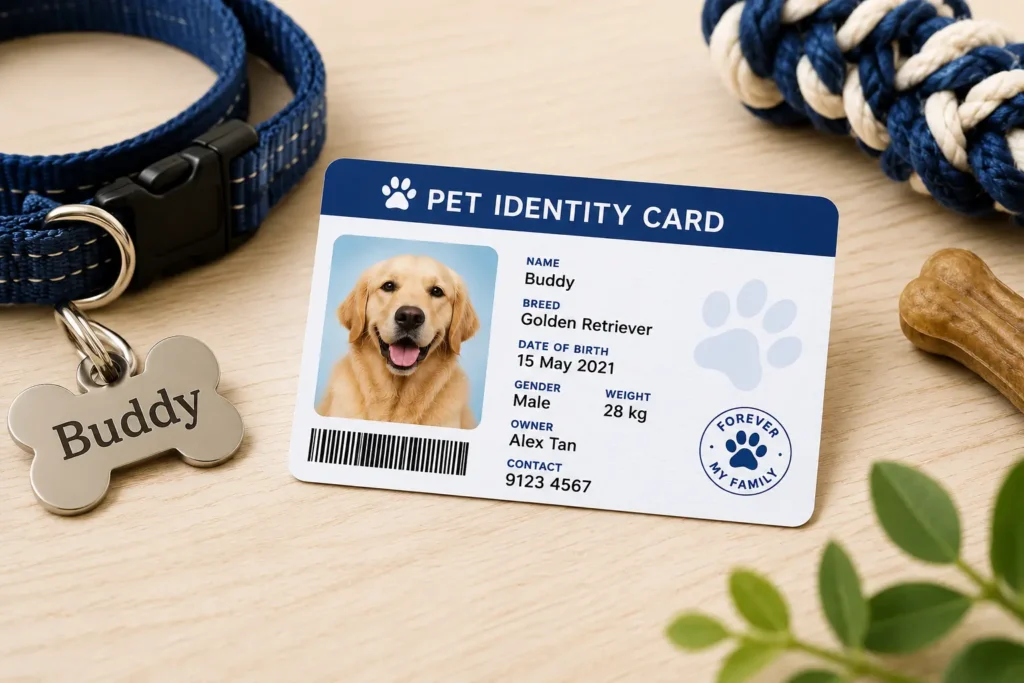
In recent years, personalised pet products have grown in popularity across Singapore. Among these, our pet ID card printing service has emerged as a unique keepsake format that combines personalisation, durability, and professional print quality.
Unlike traditional identification tags, the pet ID card Singapore pet owners create today is often designed as a meaningful keepsake. This guide explores how pet ID cards are used, what design considerations matter, and how printing choices influence the final resu
Table of Contents
- What Defines a Pet ID Card Today
- Why Personalised Pet Keepsakes Are Increasingly Common
- When Pet ID Cards Are Created
- Design Considerations and Personalisation Options
- Materials and Print Quality Considerations
- How to Approach Pet ID Card Design Thoughtfully
- Evaluating Printing Quality and Reliability
- Final Thoughts
What Defines a Pet ID Card Today?
Unlike traditional identification tags, which prioritise durability and visibility in outdoor settings, a pet ID card Singapore users design today typically follows a different purpose. It adopts characteristics from standard identification cards — including fixed dimensions, balanced layouts, and high-resolution printing — to create a more refined visual output.
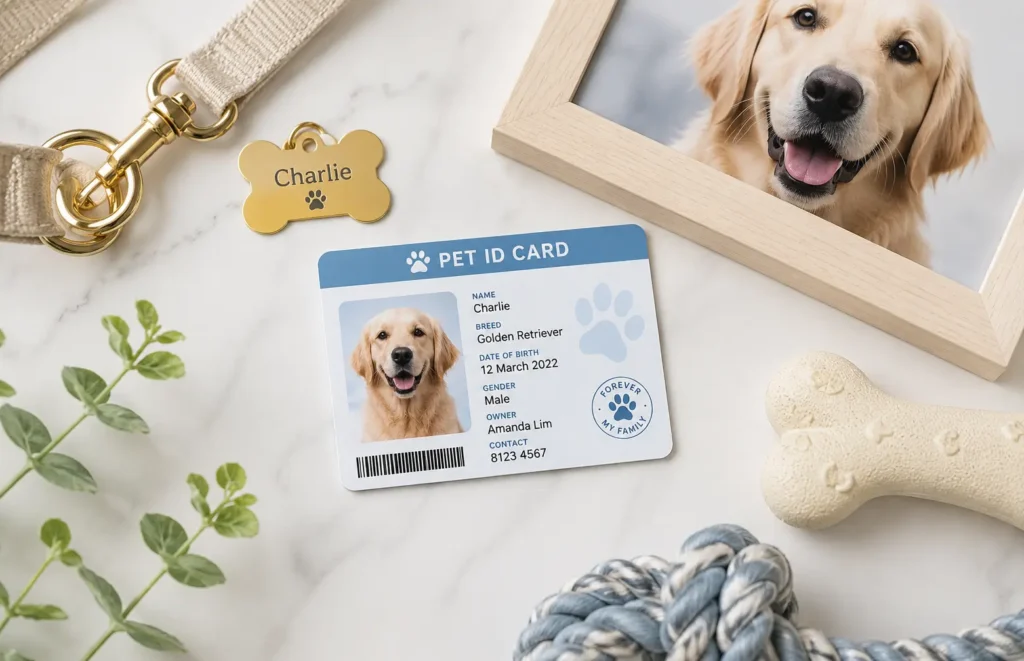
In practice, this means the card is less about utility and more about presentation. The inclusion of elements such as a pet’s photograph, name, and selected details is guided not just by necessity, but by design considerations.
Why Personalised Pet Keepsakes Are Increasingly Common
The growth of personalised pet products reflects a broader shift in how printed materials are used.
Rather than focusing purely on function, many printed items are now created to:
- Preserve moments
- Represent identity
- Provide a tangible form of memory
In this context, pet ID cards fit within a wider category of personalised print products. Similar principles can be observed across other formats, such as photo books or printed keepsakes.
If you’re exploring how these formats differ, our custom printing guide for personalised prints outlines how materials, layout, and production choices influence the final result.
You may also find it useful to refer to our upcoming guide on best personalised pet gifts in Singapore, which explores how different formats are used across occasions.
When Pet ID Cards Are Created?
Pet ID cards are typically created in response to specific moments or intentions.
Celebratory Occasions
These include birthdays or milestones, where the design tends to be more expressive and visually distinct.
Personal Documentation
Some pet owners prefer to create a structured representation of their pet’s details, even if it is not used for identification.
Memorial Contexts
In certain cases, the card is designed as a tribute. These tend to follow a more restrained visual style, with careful attention to layout and tone.
For approaches that involve preserving multiple memories, the same principles can be extended to longer formats. Our guide on how to print a personalised photo book provides additional perspective on structuring visual content meaningfully.
You may also refer to our upcoming guide on memorial pet keepsakes and gift ideas for broader context.
Design Considerations and Personalisation Options
One of the defining characteristics of a pet ID card is its flexibility in design.
Common elements include:
- Pet name and basic details
- A central photograph
- Supporting text or identifiers
- Visual accents such as icons or patterns
However, the effectiveness of the design depends less on how much is included, and more on how well it is structured.
A well-designed card typically prioritises:
- Clarity of information
- Visual balance
- Consistency in layout
This is why many designs adopt structured formats, such as ID-style layouts, where spacing and alignment play a key role.
Materials and Print Quality Considerations
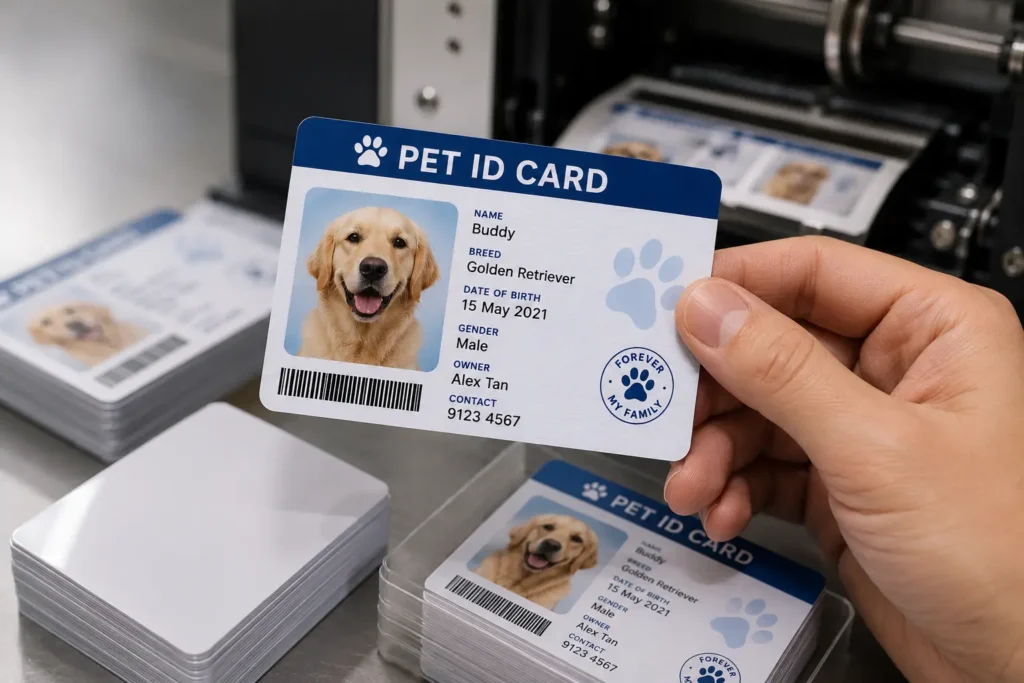
Material selection directly influences both the appearance and longevity of the card.
Most pet ID cards are produced using:
- PVC or polycarbonate substrates
- Protective finishing layers
- High-resolution printing processes
These choices determine:
- Surface durability
- Colour accuracy
- Resistance to wear
Standardised sizing (similar to ID-1 card formats) also contributes to consistency in production.
For those considering producing multiple items, the relationship between quantity and cost becomes relevant. While not specific to pet ID cards, the same principles are discussed in our guide on short run vs bulk printing.
How to Approach Pet ID Card Design Thoughtfully
Designing a pet ID card is less about adding elements and more about making deliberate choices.
A few practical considerations include:
Prioritising Key Information
Only include details that contribute to the purpose of the card.
Maintaining Visual Balance
Spacing and alignment are often more important than decorative elements.
Selecting Appropriate Imagery
Image quality has a direct impact on print clarity.
Matching Design to Intent
The tone of the design should reflect whether the card is intended as a keepsake, a display item, or a personal record.
These considerations are consistent with broader print design practices, where clarity and structure tend to produce better results than complexity.
Evaluating Printing Quality and Reliability
Even a well-designed card depends on how it is produced.
Key factors to consider when evaluating a printing provider include:
- Consistency of colour output
- Precision of cutting and finishing
- Material quality
These factors are not unique to pet ID cards and apply across most print formats.
If you’re comparing providers, our guide on choosing book printing services in Singapore outlines a practical framework for assessing print quality and reliability.
A Practical Approach to Pet ID Card Printing

At Print Print, pet ID card printing is approached as part of a broader custom printing process rather than an isolated product.
This involves:
- Understanding the intended use of the card
- Aligning material selection with expected durability
- Reviewing layouts to ensure clarity in print
- Maintaining consistency across different printed items
This reflects the same structured approach applied across our custom printing services in Singapore, where planning and execution are treated as connected steps rather than separate decisions.
For those looking to explore this format further, our pet ID card printing service in Singapore provides an overview of available options.
Final Thoughts:
Pet ID cards reflect a broader shift in how printed formats are used — moving beyond purely functional identification towards structured, personalised keepsakes.
By combining fixed layouts with customisable elements, they offer a format that balances clarity, durability, and personal expression. This makes them particularly suited for gifts and long-term keepsakes where consistency and presentation matter.
As with any print product, the final outcome depends on how well design, material selection, and production processes are aligned. In practice, small decisions — such as layout spacing, image quality, and material choice — can significantly influence how the card looks and performs over time.
If you are planning a pet ID card and want guidance grounded in real production considerations, contact our team for a consultation and project quote.
