


Choosing how a tote bag is printed affects more than its appearance. Printing method can influence artwork complexity, surface feel, production quantity, durability and overall project cost. Two common approaches are screen printing and heat transfer. Neither is automatically superior in every situation.
Businesses can explore our tote bag printing service for current production options. Our tote bag design guide covers artwork preparation separately.
This guide compares screen printing vs heat transfer tote bags so buyers can understand which method is more suitable for their artwork, quantity, material and expected use.
Table of Contents
- Screen Printing vs Heat Transfer Tote Bags: Quick Answer
- How Screen Printing Works
- How Heat Transfer Works
- Screen Printing vs Heat Transfer: Key Differences
- Which Is Better for Different Artwork?
- How Quantity and Cost Affect the Decision
- Which Method Is More Durable?
- Material Compatibility
- Real-World Buying Scenarios
- How to Choose the Right Method
- Plan Tote Bag Printing with Print Print
- Final Thoughts: Choose the Method Around the Project
Screen Printing vs Heat Transfer Tote Bags: Quick Answer
Screen printing often makes sense for bold artwork, limited colours and larger quantities.
Heat transfer can offer greater flexibility for detailed, multi-colour artwork and smaller production runs.
| Factor | Screen Printing | Heat Transfer |
|---|---|---|
| Simple logos | Strong option | Suitable |
| Many colours | More setup may be required | Often flexible |
| Larger quantities | Often attractive | Depends on process |
| Smaller quantities | Setup may be less efficient | Often practical |
| Detailed graphics | Depends on artwork | Often suitable |
| Surface feel | Ink applied to material | Transfer applied using heat/pressure |
| Durability | Strong when properly produced | Strong when properly matched/applied |
The final choice should consider the whole project rather than one characteristic alone.
How Screen Printing Works
Screen printing uses a prepared screen to transfer ink onto the tote bag.
Each colour normally requires corresponding production preparation.
This makes the process particularly suitable for artwork such as:
- corporate logos
- text
- bold illustrations
- flat colours
- straightforward campaign graphics
Screen printing can become efficient when the same artwork is reproduced across a larger number of bags because the initial preparation is spread across more units.
However, increasing the number of colours can add production complexity.
The material also matters. Textured canvas, for example, does not behave exactly like a completely smooth surface.
How Heat Transfer Works
Heat transfer uses controlled temperature and pressure to apply prepared artwork onto the bag.
Depending on the production process, this can provide flexibility for:
- smaller quantities
- more colours
- detailed designs
- artwork that would require more complicated screen preparation
The transfer needs to be appropriate for the bag surface.
A heat process that works well with one textile may not automatically be appropriate for another material.
This is why the material should be confirmed before selecting the method.
Screen Printing vs Heat Transfer: Key Differences

The main difference for buyers is not simply how the artwork gets onto the bag.
The two methods can influence:
- production setup
- colour complexity
- quantity economics
- print texture
- artwork suitability
- material compatibility
Screen printing may become attractive when the artwork is straightforward and the quantity is high enough to justify setup.
Heat transfer can be more flexible where quantity is smaller or the artwork contains greater detail.
Neither statement should be treated as a universal pricing rule. Actual quotations depend on the printer, material, artwork and production specification.
Which Is Better for Different Artwork?
Corporate Logo
A simple one- or two-colour company logo may be particularly suited to screen printing.
There may be little benefit in selecting a more complex process if the artwork itself is straightforward.
Multi-Colour Illustration
Heat transfer may offer additional flexibility when artwork contains several colours or detailed graphic elements.
Fine Text
Very small typography can be affected by material texture regardless of printing method.
The artwork should therefore be reviewed at its intended physical size.
Large Design
Large printed areas require consideration of both appearance and how the bag will fold during use.
If the design is likely to be repeatedly creased, durability and placement deserve extra attention.
Our tote bag design guide explains artwork, print dimensions and safe areas in greater depth.
How Quantity and Cost Affect the Decision
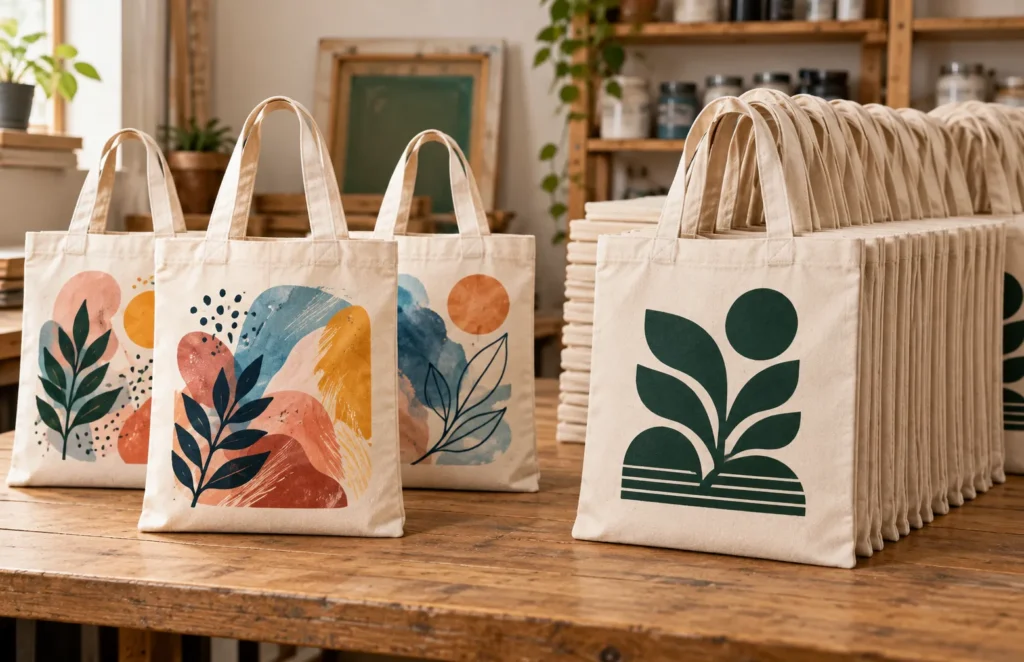
Quantity is one of the most important commercial considerations.
Screen printing usually involves initial preparation before the first bag is produced.
When hundreds of identical bags are required, this preparation can be distributed across the order.
For a much smaller order, another method may be operationally more practical.
Heat transfer can therefore become attractive for selected short runs, but its economics still depend on:
- artwork dimensions
- colour complexity
- material
- application time
- quantity
- timeline
Our tote bag printing cost guide explains the wider cost factors involved in a custom bag project.
Do not assume that screen printing is always cheaper for every large order or heat transfer is always cheaper for every small order. Ask for a quotation based on the actual specification.
Which Method Is More Durable?
There is no responsible answer that says one method always lasts longer.
Durability depends on:
- material compatibility
- ink or transfer quality
- production settings
- curing or bonding
- artwork placement
- repeated folding
- friction
- care after production
A correctly produced print using a suitable method may perform better than a poorly applied process that is theoretically considered more durable.
For a deeper explanation of print wear, our guide on why tote bag prints fade covers cracking, peeling, abrasion and care.
Material Compatibility
Canvas
Canvas can work effectively with bold printed artwork, although visible weave can influence fine details.
Non-Woven PP
Non-woven PP behaves differently from canvas and can have different heat sensitivities and surface characteristics.
Our non-woven tote bag material guide explains the material in more detail.
Paper
Paper bags are a different substrate and should not automatically be treated according to the same fabric-printing comparison.
For broader material selection, read our complete tote bag material guide.
Real-World Buying Scenarios
500 Corporate Event Tote Bags With a Simple Logo
Screen printing may be worth considering because the artwork is simple and the quantity is relatively substantial.
30 Bags With Detailed Multi-Colour Artwork
Heat transfer may provide greater production flexibility, depending on the material.
Retail Merchandise Intended for Repeated Use
Durability, surface feel and print appearance become particularly important. A sample may be useful where practical.
Corporate Gift Bags
The printing method should support the desired presentation rather than being selected in isolation.
Our best tote bag material for corporate gifts guide explains the broader gifting decision.
Dark-Coloured Tote Bags
Logo colour and printing method may need to be considered together. Our upcoming best tote bag colour for printing guide covers contrast and background selection.
How to Choose the Right Method
Ask the printer to review:
- bag material
- artwork file
- number of colours
- print dimensions
- total quantity
- expected use
- required timeline
Then choose the production approach that best satisfies the complete specification.
The aim should not be to prove that one method is universally better.
It should be to use the right method for the specific project.
Plan Tote Bag Printing with Print Print

Through our custom printing services, businesses, schools, event organisers and individuals can coordinate material, artwork, quantity and production requirements.
Explore our tote bag printing service, or WhatsApp Print Print with your artwork, bag type and required quantity for practical guidance on a suitable printing approach.
Final Thoughts: Choose the Method Around the Project
The comparison between screen printing vs heat transfer tote bags ultimately comes down to context.
Screen printing can work particularly well for simple branded artwork and larger production quantities.
Heat transfer can provide greater flexibility for detailed artwork and selected smaller runs.
Material, durability, colour, quantity and artwork all need to be considered together.
For project-specific guidance, contact us for a consultation on choosing the right tote bag printing method.
Related Posts
- Custom Tote Bag Printing in Singapore: Smart Branding That Lasts (2026)
- Tote Bag vs Flyers: Choosing the Right Marketing Tool for Each Scenario (2026)
- Tote Bag Printing Planning Guide: Timelines, Quantities & Execution
