


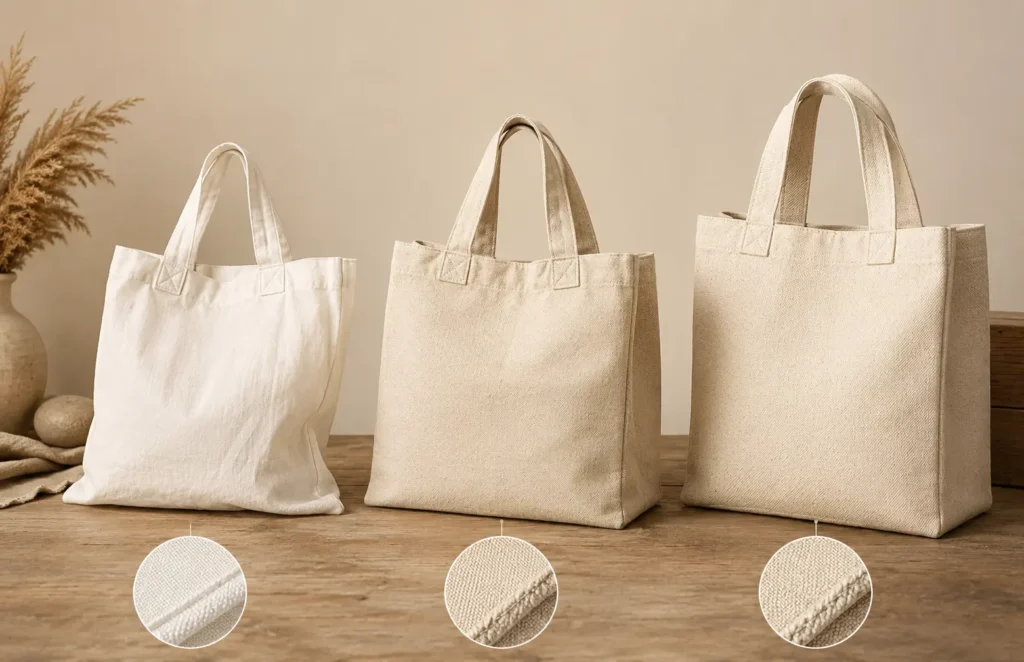
Tote bag thickness affects more than how a bag feels. It influences structure, carrying performance, storage requirements, print appearance, cost and the overall impression your branded bag creates.
Businesses preparing a custom order can explore our tote bag printing service. Those new to the process may also begin with our custom tote bag printing guide for a broader overview of materials, printing methods and campaign uses.
Table of Contents
- What Does Tote Bag Thickness Mean?
- GSM vs Oz: Understanding Fabric Weight
- Lightweight, Medium and Heavyweight Tote Bags
- How Thickness Differs Across Bag Materials
- How Thickness Affects Durability, Printing and Cost
- Common Mistakes and How to Choose the Right Thickness
- Choose the Right Tote Bag Thickness with Print Print
- Final Thoughts: Choose Thickness with Purpose
What Does Tote Bag Thickness Mean?
When buyers discuss tote bag thickness, they may be referring to several related characteristics:
- material weight
- weave density
- stiffness
- opacity
- overall structure
- perceived durability
These characteristics are connected, but they are not identical.
For example, a heavier canvas fabric may feel more substantial than a lighter one. However, the finished bag’s performance also depends on:
- fibre composition
- weave construction
- seam quality
- handle attachment
- gusset design
- reinforcement
- overall dimensions
A thick body material does not automatically create a strong tote bag. Weak handles, narrow seams or poor stitching can still reduce carrying performance.
Tote bag thickness should therefore be considered as one part of the complete bag specification—not the only measurement of quality.
GSM vs Oz: Understanding Fabric Weight
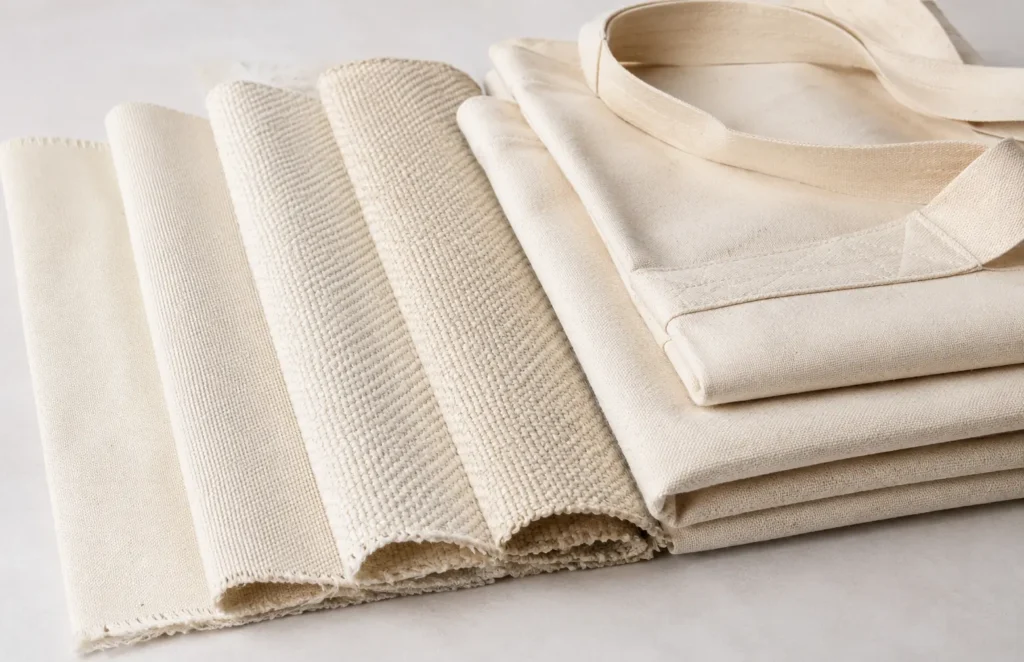
Two measurements frequently appear when comparing tote bags: GSM and oz.
What Is GSM?
GSM means grams per square metre.
It measures how much one square metre of material weighs. A higher GSM generally indicates that more material is present within the same surface area.
However, GSM measures material weight rather than physical thickness alone. Two fabrics with similar GSM figures may still feel different because of their:
- fibre composition
- weave
- finishing
- flexibility
- surface texture
GSM is often used for non-woven PP bags, paper bags and some canvas products.
What Does Oz Mean?
Canvas and other woven fabrics may also be described using ounces per square yard.
A higher ounce rating generally indicates a heavier canvas fabric. Suppliers may describe their products as:
- lightweight canvas
- medium-weight canvas
- heavyweight canvas
These descriptions are useful, but the definition of “heavyweight” may vary between suppliers. Buyers should compare the stated fabric weight and, where possible, review an actual material sample.
GSM and Oz Conversion
As an approximate conversion:
1 oz per square yard is approximately 33.9 GSM.
| Canvas Weight | Approximate GSM |
|---|---|
| 4 oz | 136 GSM |
| 6 oz | 203 GSM |
| 8 oz | 271 GSM |
| 10 oz | 339 GSM |
| 12 oz | 407 GSM |
| 14 oz | 475 GSM |
These figures help buyers compare specifications, but they should not be treated as guaranteed load-capacity ratings.
Two 10 oz canvas fabrics may still differ in weave tightness, composition, finish and overall strength.
Lightweight, Medium and Heavyweight Tote Bags
There is no universally ideal tote bag thickness. The right choice depends on how the bag will be used.
Lightweight Tote Bags
Lightweight bags are useful for large-volume campaigns involving brochures, samples, registration packs or other light contents. They are easier to fold, store and distribute, while generally keeping unit costs lower.
Their limitations are reduced structure and lower suitability for repeated use with heavier contents.
Medium-Weight Tote Bags
Medium-weight options provide a practical balance of cost, structure and usability. They commonly suit exhibitions, training programmes, school merchandise, employee packs and branded retail packaging.
They feel more substantial than basic promotional bags without requiring the cost and storage space of heavyweight canvas.
Heavyweight Tote Bags
Heavyweight tote bags are most suitable when the bag is part of the gift, merchandise or overall brand experience. Common applications include premium corporate gifts, retail products, bookstores and membership packs.
They provide greater structure and perceived value but may cost more, require additional storage and need properly reinforced handles and seams.
How Thickness Differs Across Bag Materials
A GSM figure cannot be interpreted without considering the type of material.
Canvas, non-woven PP and paper behave differently, even when their stated weights appear similar.
Canvas Tote Bags
Canvas is a woven fabric commonly described using ounces or GSM.
Heavier canvas generally provides more structure and a firmer feel. However, weave density and fibre composition also influence how it performs.
Canvas is often selected for:
- repeated use
- branded merchandise
- corporate gifts
- books and documents
- premium promotional campaigns
Our canvas tote bag material guide provides a more detailed explanation of canvas construction, print suitability and recommended uses.
Non-Woven PP Bags
Non-woven polypropylene is usually specified in GSM.
A higher GSM may provide:
- greater opacity
- improved structure
- a more substantial feel
However, non-woven PP should not be compared directly with canvas based on GSM alone. The two materials have different construction, texture and carrying characteristics.
Non-woven PP bags are frequently chosen for:
- roadshows
- exhibitions
- event packs
- mass distribution
- budget-sensitive promotional campaigns
Paper Bags
Paper bags may also be described using GSM, but their performance depends on more than paper weight.
Buyers should also assess:
- handle type
- base reinforcement
- moisture exposure
- expected contents
- whether the bag is intended for single or repeated use
Paper bags are generally more suitable for:
- retail packaging
- gift presentation
- product launches
- lightweight merchandise
For a broader overview of these material differences, readers can refer to the complete tote bag material guide.
How Thickness Affects Durability, Printing and Cost
A heavier material may provide greater structure and resistance to wear, but carrying capacity also depends on handles, seams, stitching, gussets and bag dimensions. Buyers should tell the printer what the bag will carry rather than selecting material weight in isolation.
Thickness and texture also influence print appearance. Lightweight materials may wrinkle around large print areas, while heavyweight canvas can provide a stable surface for bold artwork. However, a pronounced weave may reduce the clarity of very small text or fine lines. Our tote bag design guide explains how artwork should be prepared for different surfaces.
Heavier materials normally cost more and require additional storage space. This may be worthwhile for premium gifts or reusable merchandise, but unnecessary for a single event involving lightweight brochures. The goal is to select the lowest specification that still performs reliably for the intended use.
For a detailed breakdown of material, quantity and production costs, read our tote bag printing cost guide.
Common Mistakes and How to Choose the Right Thickness
Common mistakes
- choosing the thickest option automatically
- comparing GSM directly across different materials
- ignoring handles, stitching and reinforcement
- selecting based only on price
- confirming material before considering the contents
Then follow with a short decision framework:
Choose Lightweight When:
- contents are light
- quantity and budget are the main priorities
- the bag is intended for a short campaign
- easy storage and distribution matter
Choose Medium Weight When:
- you need a balance between cost and reuse
- the contents are moderately heavy
- professional presentation matters
- recipients may continue using the bag
Choose Heavyweight When:
- the bag forms part of a gift or retail product
- premium presentation is important
- repeated use is expected
- heavier contents will be carried
Choose the Right Tote Bag Thickness with Print Print
Choosing the right tote bag thickness requires balancing material weight, bag construction, printing, quantity and real-world use.
At Print Print, we help businesses, schools, event organisers and individuals assess these requirements before production. Through our custom printing services, clients can coordinate branded materials for corporate campaigns, events, retail packaging and personalised projects.
Explore our tote bag printing service to discuss suitable material weights, printing options, artwork and quantities for your next custom bag order.
Final Thoughts: Choose Thickness with Purpose
Tote bag thickness affects structure, durability, printing, storage and cost—but thicker does not automatically mean better.
The right option should:
- support the expected contents
- match the intended campaign
- present the brand appropriately
- work with the selected artwork
- remain practical for the required quantity
- provide value without unnecessary cost
By considering material weight together with handles, seams, construction and intended use, businesses can choose a tote bag that performs reliably without unnecessary spending.
For recommendations based on your quantity, artwork and intended contents, contact us for a consultation on the right tote bag thickness for your event, campaign or custom printing project.
