

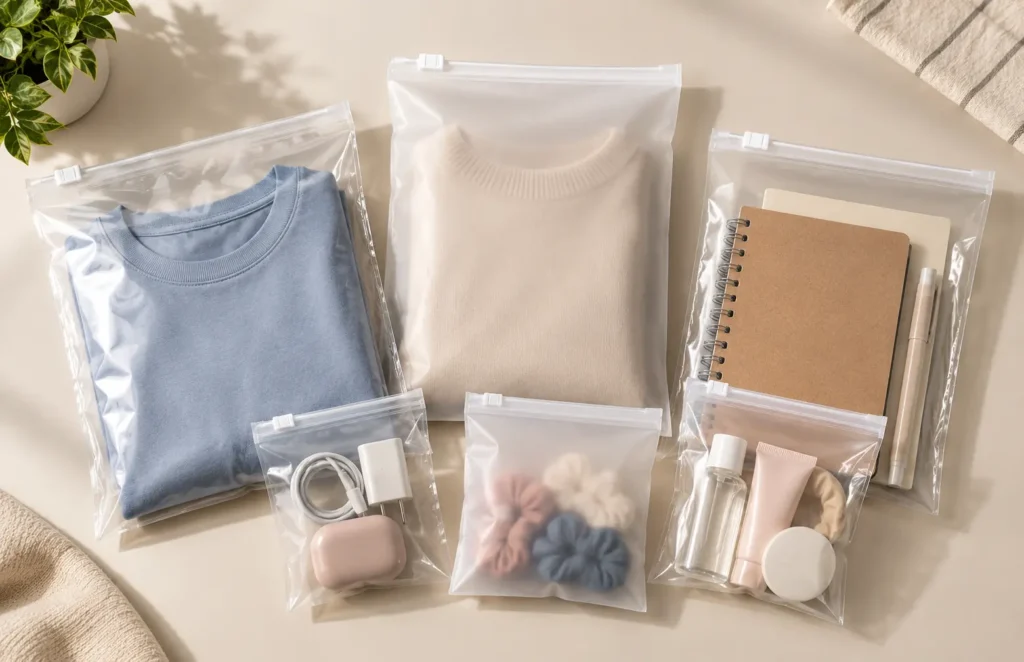
Choosing the right zipper bag size affects more than whether the product can physically fit inside.
Size influences presentation, packing efficiency, product protection, branding space and how practical the finished packaging feels for staff and customers. A bag that is too small may be difficult to pack, while one that is too large can make the product feel loose, waste material and weaken presentation.
Print Print offers custom zipper bags in transparent PE and frosted EVA options, with custom sizes, thicknesses and printing available according to project requirements. Businesses sourcing packaging as part of a wider project can also explore Print Print’s custom printing services in Singapore.
This zipper bag size guide explains how to choose the right size based on what the bag will carry, how product thickness affects fit and how dimensions relate to printing and packaging performance.
Table of Contents
- What Zipper Bag Size Should You Choose?
- Understanding Width, Height and Closure Allowance
- Choose Zipper Bag Size Based on What It Will Carry
- How Product Thickness Affects Fit
- How Zipper Bag Size Affects Printing
- Size, Material and Function Work Together
- Common Zipper Bag Sizing Mistakes
- Practical Zipper Bag Size Checklist
- Plan the Right Zipper Bag Size with Print Print
- Final Thoughts: Choose Dimensions Around Real Use
What Zipper Bag Size Should You Choose?
There is no single zipper bag size that is best for every project.
The right size depends mainly on:
- what the bag needs to carry
- whether the contents are flat or bulky
- how neatly the product should sit inside
- whether the bag is for storage, retail presentation or delivery
- how much printing or branding space is needed
- how the finished product should look in customers’ hands
Quick Answer
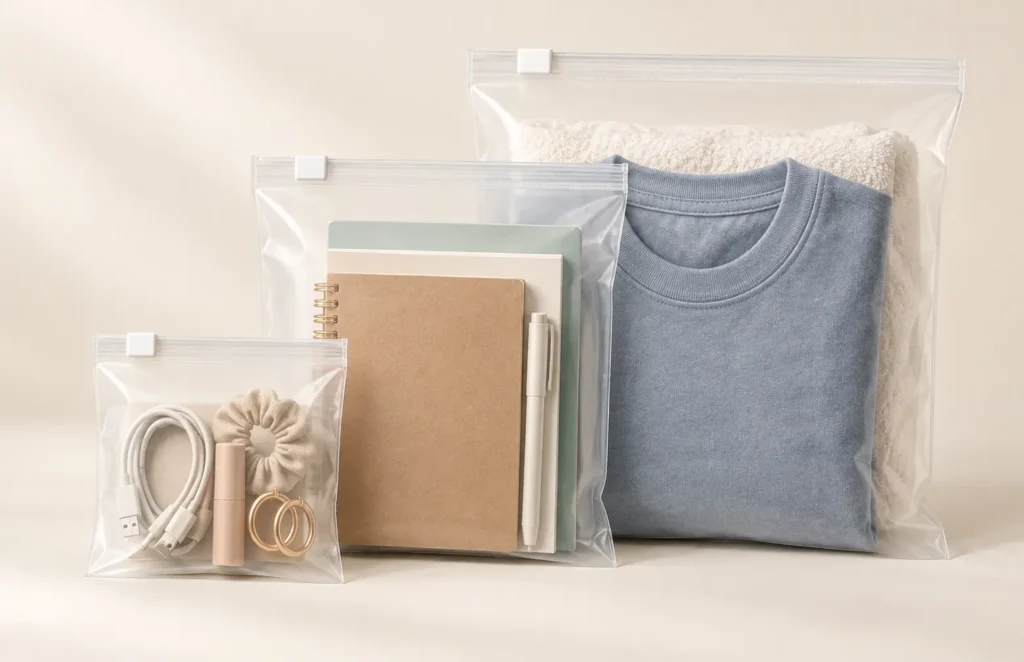
For small accessories or compact retail items, a smaller format may be more suitable.
For documents, notebooks or mid-sized products, a medium format is often more practical.
For folded garments, towels or bundled products, a larger custom size may be more appropriate.
The best approach is to start with the actual contents and work outward, rather than choosing a size label first.
Understanding Width, Height and Closure Allowance
Zipper bag sizing is easiest to understand when broken into practical measurements.
Width
Width measures across the front of the bag.
This determines how much horizontal space the product has and whether it can sit comfortably without bending or crowding the edges.
Height
Height measures from the base of the bag to the top opening area.
This affects whether the product can fit fully inside while leaving enough space for proper closure.
Closure Allowance
A zipper bag also needs some space near the top for the opening and closure area.
If the product is packed too tightly up to the seal, the bag may become difficult to close or may not present neatly.
For that reason, businesses should not match the product dimensions exactly to the bag dimensions. It is usually better to allow practical clearance for inserting, arranging and closing the bag properly.
A useful starting point is to think in terms of:
Product width + product height + packing allowance
rather than choosing a bag based only on rough appearance.
Choose Zipper Bag Size Based on What It Will Carry
The intended contents should always come first.
Clothing and Apparel
Folded garments need space not only for width and height, but also for folded thickness.
A T-shirt, blouse or knitwear item may appear compact on its own, but once folded and placed in packaging, it still needs enough room to slide in smoothly and sit neatly.
If the bag is too tight, packing becomes slower and the presentation may look strained.
Books, Documents and Printed Materials
Flat products such as workbooks, notebooks or printed materials usually need a size that exceeds the actual dimensions of the item.
This helps prevent the corners from catching during insertion and leaves enough room for the zipper closure to work comfortably.
Towels and Textiles
Textile products often look deceptively simple to size, but their folded depth matters.
A towel may have modest width and height once folded, but still create more bulk than a notebook or document set.
This makes thickness allowance especially important.
Accessories and Retail Products
Accessories, pouches, merchandise kits and retail sets often involve multiple smaller items grouped together.
In these cases, the combined size matters more than the size of the largest single item.
It is usually better to test the full packaged set rather than measuring each component separately.
How Product Thickness Affects Fit
Thickness is one of the most commonly overlooked parts of choosing a zipper bag size.
A flat item and a bulky folded item may have similar width and height, but they will not behave the same way once packed.
For example:
- a workbook is mostly flat
- a folded T-shirt has depth
- a towel has even more bulk
- a product set with multiple pieces may create irregular thickness
A bag that technically fits the width and height may still be unsuitable if the contents create too much pressure once inserted.
This is why it is helpful to assess:
- folded width
- folded height
- folded thickness
- ease of insertion
- ability to close the zipper neatly
When in doubt, pack a mock-up or sample product first rather than relying only on visual estimates.
How Zipper Bag Size Affects Printing
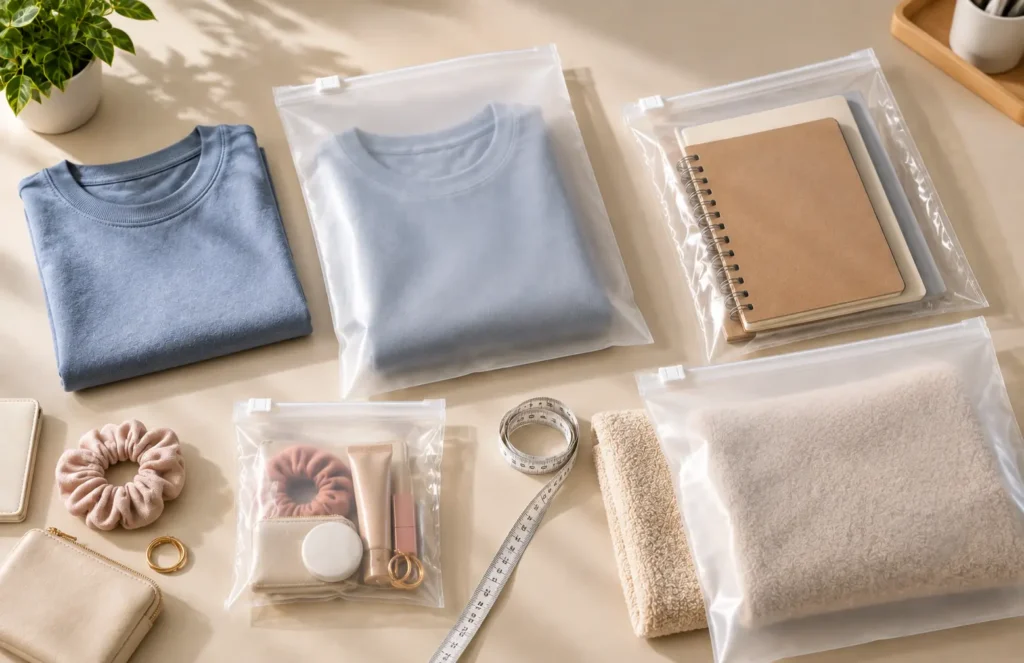
Bag size and print size are related, but they are not the same thing.
A larger zipper bag may offer more visible surface area, but not every part of that area will necessarily be ideal for printing.
The size of the bag influences:
- how prominent the logo appears
- how much empty space surrounds the branding
- whether text remains easy to read
- how balanced the overall design feels
A small logo may look neat and understated on a compact bag, but appear too insignificant on a much larger one.
Likewise, simply enlarging the artwork because the bag is bigger does not automatically create a better result.
Good packaging design depends on proportion.
Bag size should also be considered alongside material finish, as transparent and frosted surfaces can present the same product differently. Our frosted vs clear zipper bags guide compares the two finishes based on product visibility, branding and retail presentation.
Size, Material and Function Work Together
Zipper bag size should not be chosen in isolation from material and intended use.
For example, the way a transparent PE bag presents a product may differ from a frosted EVA bag, even when the dimensions are similar. Product visibility, packing neatness and branding emphasis all interact with size.
A larger bag is not automatically better just because it feels safer.
Oversizing can create:
- unnecessary empty space
- weaker presentation
- more movement inside the bag
- more material usage
- a less tailored appearance
The aim is not simply to fit the product, but to fit it well.
Common Zipper Bag Sizing Mistakes
Choosing a Bag That Is “Just Big Enough”
A very tight fit can slow down packing and make the finished bag look strained.
Always allow some working room.
Choosing Oversized Bags “Just in Case”
Oversized packaging can make the product feel loose or under-presented.
It may also use more material than necessary.
Measuring Only Width and Height
If the product has depth, folded thickness must also be considered.
Ignoring the Full Product Set
If several items will be packed together, test the complete bundle rather than just one item.
Forgetting About Branding
A bag may fit the contents well but leave the artwork looking too small or poorly balanced.
Packaging dimensions and print planning should be considered together.
Practical Zipper Bag Size Checklist
Before requesting a quotation, confirm:
- what the bag will carry
- dimensions of the product when packed
- folded thickness or bulk
- whether several items will be packed together
- how much clearance is needed for easy insertion
- preferred material finish
- whether branding will be printed
- approximate artwork size
- quantity required
- delivery timeline
Providing these details together makes it easier to recommend a suitable specification.
Quantity should also be considered early because plain and custom-printed packaging may involve different production requirements. Our short-run vs bulk printing guide explains the broader trade-offs businesses should consider when deciding how much to produce. If the bags are required for a product launch, event or fixed delivery date, allow enough time for artwork confirmation and production. Print Print’s last-minute printing guide explains why urgent custom-printing projects leave less room for revisions and production adjustments.
Plan the Right Zipper Bag Size with Print Print
Choosing the right dimensions starts with understanding how the finished packaging will actually be used.
Print Print supplies custom zipper bags for apparel, books, documents, accessories and retail packaging. Businesses can discuss custom sizes, material finishes, thicknesses and printing requirements according to their intended products. When comparing suppliers for a customised project, it is also worth considering factors such as print quality, customisation options, turnaround time and communication. Our guide to choosing a printing service in Singapore covers these broader considerations in more detail.
If you are coordinating zipper bags alongside other printed materials, you can also explore Print Print’s custom printing services.
For the most useful size recommendation, prepare your product measurements, estimated quantity, preferred finish and artwork requirements before contacting the team.
Final Thoughts: Choose Dimensions Around Real Use
A useful zipper bag size guide should not simply tell you to choose small, medium or large.
The right dimensions depend on what needs to fit inside, how bulky the contents are, how the packaging should look and how the printed branding should appear.
Before placing an order, consider:
- width
- height
- closure allowance
- folded thickness
- material finish
- branding space
- quantity
- actual use case
A zipper bag that matches the product properly will usually perform better than one selected only because it seems safer or cheaper.
For recommendations based on your product dimensions, preferred finish, quantity and artwork requirements, contact Print Print through our enquiry form for a customised zipper bag quotation.
Related Posts
- Tote Bag Size Guide: How to Choose the Right Size for Your Products
- Tote Bag Design Guide: Create Artwork That Prints Perfectly (2026)
- The Complete Tote Bag Material Guide: Choose the Best Fabric for Your Brand (2026)
