

Choosing a zipper bag material affects much more than whether the packaging looks clear or frosted. The material influences product visibility, overall presentation, how branding appears and how suitable the bag feels for different products.
Print Print currently offers custom zipper bags in transparent PE and frosted EVA materials, with custom sizes, thicknesses and printing available according to project requirements. Businesses coordinating packaging with other branded products can also explore Print Print’s wider custom printing services in Singapore.
This guide compares PE vs EVA zipper bags, explains how the two materials differ and helps businesses choose based on what they actually need to pack.
Table of Contents
- What Are PE and EVA Zipper Bags?
- Quick Answer: PE vs EVA Zipper Bags
- What Is a PE Zipper Bag?
- What Is an EVA Zipper Bag?
- PE vs EVA Zipper Bags at a Glance
- Which Material Offers Better Product Visibility?
- Which Material Is Better for Clothing?
- Which Material Suits Documents and Retail Products?
- How Material Choice Affects Printed Branding
- Why Size and Thickness Still Matter
- Can Clear and Frosted Materials Be Combined?
- Common Material Selection Mistakes
- Choose the Right Material with Print Print
- Final Thoughts
What Are PE and EVA Zipper Bags?
PE and EVA refer to two different material options that can be used for resealable zipper packaging.
For Print Print’s zipper bag range:
- PE is used for transparent packaging
- EVA is used for the frosted option
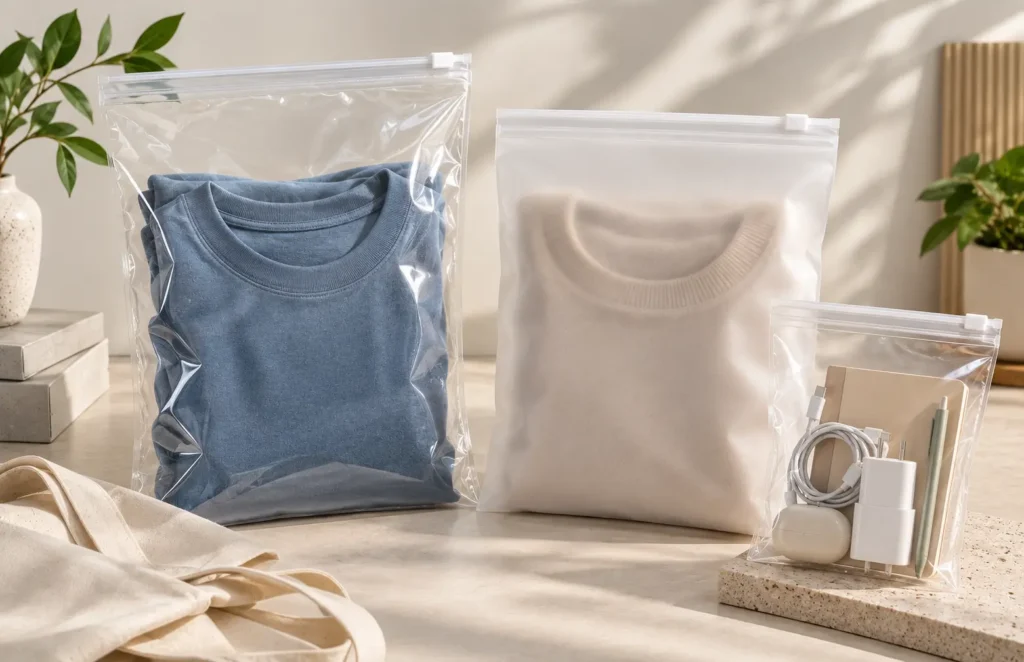
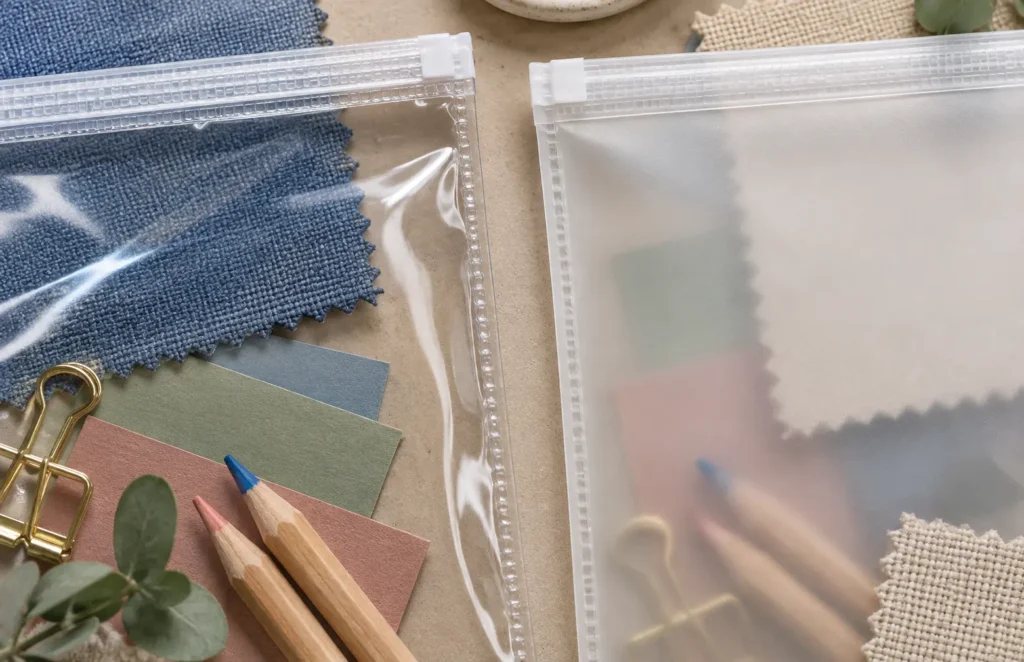
The difference is immediately visible. PE provides clearer product visibility, while EVA creates a softer translucent appearance.
However, choosing between them should not be based on appearance alone. Businesses should also consider what is being packed, how easily customers need to identify it and how the packaging will interact with printed branding.
Quick Answer: PE vs EVA Zipper Bags
Choose PE zipper bags when:
- high product visibility matters
- customers or staff need to identify contents quickly
- the contents themselves are part of the presentation
- you prefer a transparent finish
Choose EVA zipper bags when:
- you want a frosted, softer appearance
- full product visibility is less important
- you prefer greater visual separation between branding and contents
- the packaging forms a stronger part of the overall presentation
Neither material is automatically better. The better choice is the one that suits the product and intended use.
What Is a PE Zipper Bag?
PE stands for polyethylene, a widely used plastic material found across many types of packaging.
For Print Print’s zipper bags, the PE option provides a transparent finish.
This can be useful for:
- clothing
- books
- documents
- stationery
- accessories
- retail merchandise
The main advantage in this context is visibility. A retailer carrying several colours or variants can identify the contents without repeatedly opening the bag. Similarly, documents or notebooks remain easier to distinguish during storage and distribution. Because the contents remain highly visible, businesses should also consider how neatly products will appear once packed. With clear packaging, the product becomes part of the visual design.
What Is an EVA Zipper Bag?
EVA stands for ethylene-vinyl acetate.
Print Print uses EVA for its frosted zipper bag option, giving the packaging a semi-transparent rather than fully clear appearance.
The product inside remains recognisable, but finer details are softened.
Potential uses include:
- apparel
- knitwear
- towels
- textiles
- accessories
- branded retail products
- merchandise sets
The frosted appearance can create a more consistent presentation across products that vary in colour. It may also give printed branding a less visually busy background. If the main decision you are making is about appearance rather than the underlying material, our frosted vs clear zipper bags guide compares both finishes in greater detail.
PE vs EVA Zipper Bags at a Glance
Consideration
PE Zipper Bags
EVA Zipper Bags
Finish
Transparent
Frosted
Product visibility
High
Partial
Identifying contents
Very easy
Generally possible
Presentation
Direct and product-focused
Softer and more uniform
Clothing applications
Suitable
Suitable
Documents
Particularly practical
Possible
Printed branding
Available
Available
Custom sizes
Available
Available
Custom thickness
Available
Available
| Consideration | PE Zipper Bags | EVA Zipper Bags |
|---|---|---|
| Finish | Transparent | Frosted |
| Product visibility | High | Partial |
| Identifying contents | Very easy | Generally possible |
| Presentation | Direct and product-focused | Softer and more uniform |
| Clothing applications | Suitable | Suitable |
| Documents | Particularly practical | Possible |
| Printed branding | Available | Available |
| Custom sizes | Available | Available |
| Custom thickness | Available | Available |
The final result can still vary depending on bag thickness, product colour and printing specification.
Which Material Offers Better Product Visibility?
PE is the better option when clear product visibility is the priority.
For example, consider a retailer storing the same T-shirt in several colours.
With transparent PE packaging, staff can identify each colour immediately.
The same principle applies to notebooks, printed materials or accessories where recognising the item without opening the package is useful.
EVA still allows customers to see the general shape and colour of a product, but the frosted finish softens details.
Ask:
- Does someone need to see the exact contents immediately?
If yes, PE is generally the more practical choice. If only partial visibility is needed, EVA may provide the presentation you prefer.
Which Material Is Better for Clothing?
Both PE and EVA can work for garments.
The choice depends largely on presentation.
Choose PE when:
- garment colour should remain obvious
- products need to be identified quickly
- you want a clean transparent package
Choose EVA when:
- you prefer a softer presentation
- exact garment details do not need to remain fully visible
- branding should play a stronger visual role
For apparel businesses, it can be helpful to place the actual folded garment inside a sample bag before confirming the material.
How packaging looks empty is less important than how it looks around the real product.
Which Material Suits Documents and Retail Products?
For books, workbooks and documents, transparent PE can be particularly practical because covers and contents remain easy to identify.
However, EVA may still suit printed materials where full visibility is less important.
Accessories and retail merchandise can work with either material.
For example:
PE may suit:
- stationery sets
- notebooks
- colourful accessories
- products that customers need to inspect
EVA may suit:
- apparel accessories
- textile sets
- branded merchandise
- products where presentation is more important than full visibility
The appropriate choice should follow the product rather than a fixed rule.
How Material Choice Affects Printed Branding
Both materials can support custom branding according to the final printing specification.
The difference is what sits visually behind the artwork.
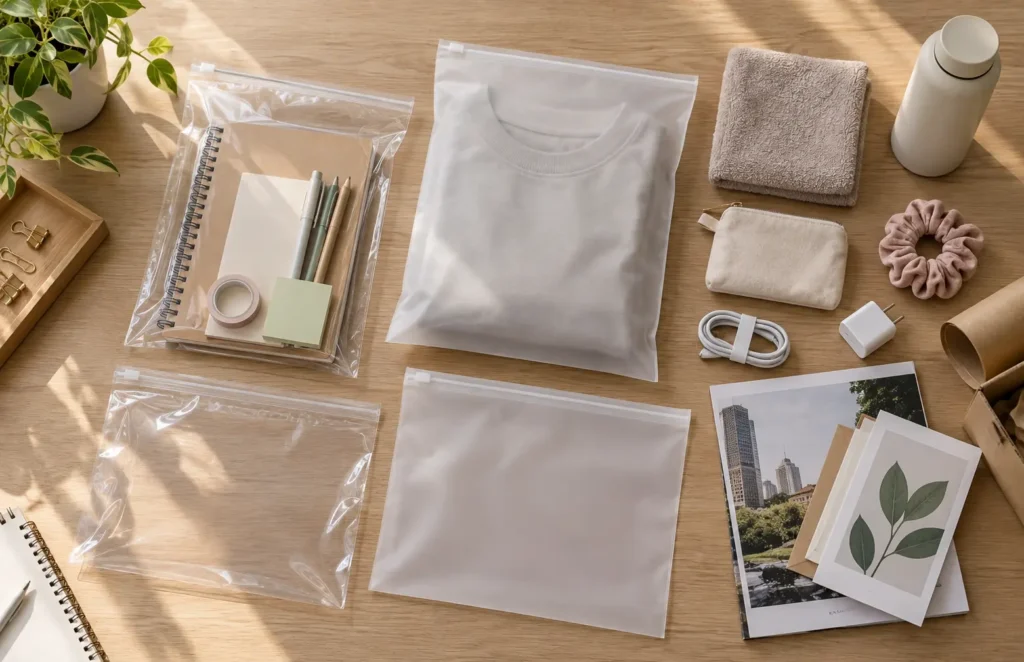
On transparent PE, the product remains visible beneath or around the logo. The contents can therefore affect how strongly certain colours or designs appear.
A frosted EVA surface reduces some of that visual competition.
Businesses planning branded packaging should consider material and artwork together rather than selecting them independently.
Our zipper bag printing guide explains logo placement, colour contrast and artwork preparation in more detail.
Why Size and Thickness Still Matter
Choosing PE or EVA does not complete the specification. Bag dimensions and thickness still need to suit the actual product. A flat document requires different packaging from a bulky towel or folded garment.
Businesses should consider:
- product width
- product height
- folded depth
- ease of insertion
- closure allowance
- desired presentation
Our zipper bag size guide explains how to choose dimensions based on the contents rather than selecting an arbitrary bag size.
Quantity should also be considered alongside the physical specification. Print Print currently lists a minimum order quantity of 200 pieces for plain zipper bags and 5,000 pieces for custom printed bags, so businesses should consider expected usage before finalising a larger customised production run. Our short-run vs bulk printing guide explains the broader trade-offs businesses should consider when deciding how much of a customised product to produce.
Can Clear and Frosted Materials Be Combined?
Businesses do not necessarily have to choose a fully PE-style clear presentation or fully frosted appearance.
Print Print currently lists configurations including:
- double clear
- double frosted
- one side clear and one side frosted
A mixed configuration can provide a useful compromise.
For example, one transparent side can keep the product easy to inspect, while the frosted side creates a softer presentation on the opposite surface.
The most suitable configuration depends on the product, intended branding and packaging requirements.
Common Material Selection Mistakes
Choosing Only Based on Appearance
The nicest-looking empty bag is not automatically the best bag for the product.
Ignoring Product Visibility
Consider whether staff or customers need to identify the contents quickly.
Treating Material and Printing Separately
The finish affects the visual background behind printed branding.
Forgetting Product Thickness
A suitable material still needs suitable dimensions and thickness.
Not Testing the Actual Contents
Whenever possible, evaluate packaging with the real product inside rather than judging an empty sample.
Material selection should also be confirmed early when the packaging is required for a launch, event or fixed delivery date. Choosing the material, dimensions and artwork too late can leave less time to review or adjust the specification before production.
Print Print’s last-minute printing guide explains why urgent custom printing projects generally leave less flexibility for revisions and production planning.
Choose the Right Material with Print Print
Print Print supplies custom zipper bags for apparel, books, documents, towels, accessories and general retail packaging.
Businesses preparing zipper bags alongside other printed items can explore our wider custom printing services in Singapore to view additional custom printing options available for different projects.
For zipper bags specifically, available specifications include transparent PE, frosted EVA, mixed clear-and-frosted finishes, custom sizes, custom thicknesses and logo printing according to project requirements.
Plain zipper bags currently start from 200 pieces, while custom printed orders start from 5,000 pieces.
Final Thoughts
Comparing PE vs EVA zipper bags is ultimately about matching the packaging to the product.
PE is the stronger choice when visibility is the priority. EVA suits projects where a frosted appearance and softer presentation are preferred.
Before deciding, consider:
- what is being packed
- how visible it needs to remain
- how the package should look
- whether branding will be printed
- bag dimensions
- required thickness
- quantity
- intended use
The most suitable zipper bag is not simply the clearest or most premium-looking option. It is the material and specification that best supports the way the product will actually be stored, presented and handled.
For help choosing between PE vs EVA zipper bags for a specific project, contact Print Print through our enquiry form with your product details and packaging requirements.
Related Posts
- The Complete Tote Bag Material Guide: Choose the Best Fabric for Your Brand
- Tote Bag Design Guide: Create Artwork That Prints Perfectly
- Tote Bag Printing Planning Guide: Timelines, Quantities & Execution
