


Choosing the right tote bag size affects much more than whether your items physically fit. Dimensions influence carrying comfort, bag structure, storage, artwork visibility, material usage and how practical the finished bag feels to recipients.
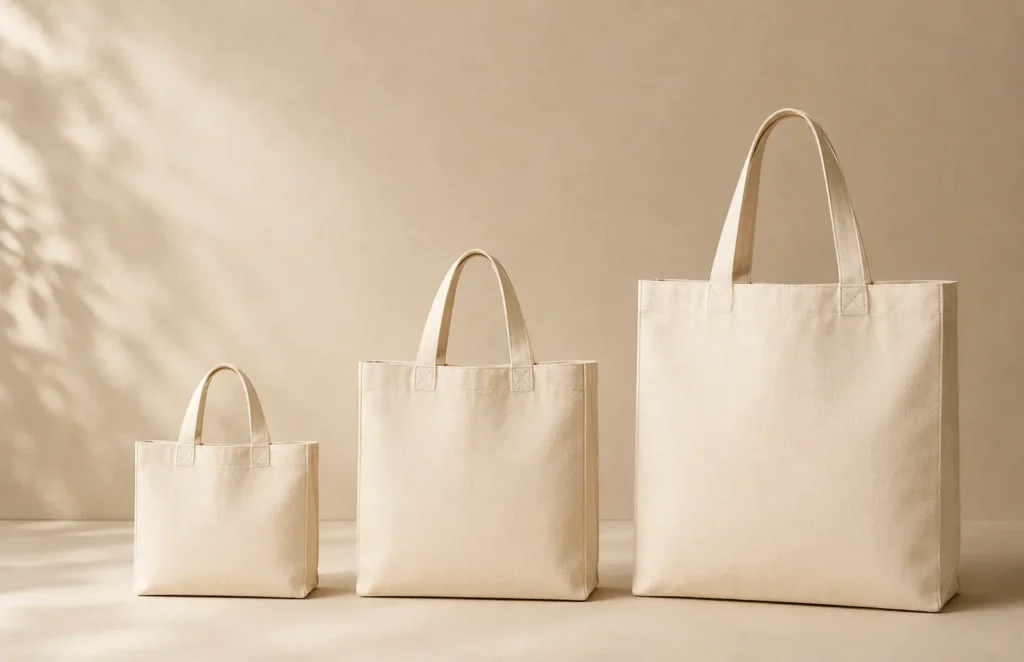
Print Print currently lists A5, A4 and A3 tote bag size options, with custom dimensions also available for special projects. Businesses preparing a custom order can explore our tote bag printing service.
This tote bag size guide explains how to choose dimensions based on what the bag will carry, how gussets change usable capacity and how size interacts with printing and material choice.
Table of Contents
- What Tote Bag Size Should You Choose?
- Understanding Width, Height and Gusset
- A5, A4 and A3 Tote Bag Size Categories
- Choose Tote Bag Size Based on What It Will Carry
- How Gussets Change Usable Capacity
- How Tote Bag Size Affects Printing
- Size, Material and Construction Work Together
- Common Tote Bag Sizing Mistakes
- Practical Tote Bag Size Checklist
- Plan the Right Tote Bag Size with Print Print
- Final Thoughts: Choose Dimensions Around Real Use
What Tote Bag Size Should You Choose?
There is no single tote bag size that is best for every project.
The most suitable dimensions depend primarily on:
- what the bag needs to carry
- how many items will be placed inside
- whether those items are flat or bulky
- whether the bag requires a gusset
- how large the printed artwork needs to appear
- how the bag will be distributed or stored
- the overall look you want to achieve
Quick Answer
For small gifts and lightweight items, a compact bag may be sufficient.
For documents, brochures, notebooks and everyday event packs, a medium format is often more practical.
For larger merchandise, clothing or bulkier campaign items, a larger bag or custom dimensions may be required.
The best approach is to start with the contents and work outward rather than choosing a bag simply because its size name sounds familiar.
Understanding Width, Height and Gusset
Tote bag dimensions are usually easier to understand when separated into three measurements.
Width
The width measures across the front of the bag.
A wider bag can accommodate larger flat items but may also change the proportions of the finished design.
Height
Height measures from the bottom of the bag body to the top edge.
Remember that handle length is normally considered separately from the bag body’s height.
Gusset
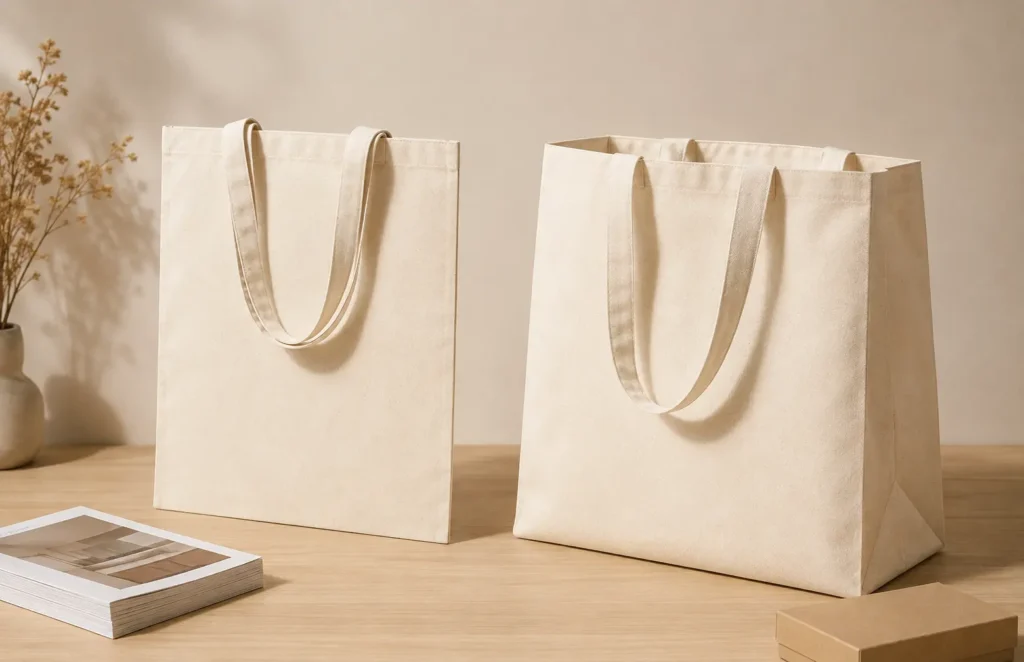
A gusset is the folded section that allows a bag to expand.
Depending on the bag, this may appear along:
- the sides
- the base
- both side and base areas
A flat bag measuring 30 cm wide does not necessarily have the same practical capacity as a 30 cm bag with an expandable gusset.
This is why a useful size specification should ideally be considered as:
Width × Height × Gusset
rather than width and height alone.
A5, A4 and A3 Tote Bag Size Categories
Print Print currently describes its standard tote bag options using A5, A4 and A3 size categories, with custom dimensions available for special projects.
These labels provide customers with an intuitive way to think about relative bag sizes.
A5-Style Tote Bags
A5-style options are the more compact category.
They may be suitable for:
- small gifts
- lightweight merchandise
- samples
- compact promotional packs
- smaller personal items
They can work well when a large bag would make the contents feel lost inside.
A4-Style Tote Bags
A4-style options provide a more versatile middle ground.
They may suit:
- brochures
- documents
- notebooks
- conference materials
- school materials
- event packs
- lightweight retail purchases
For many corporate and event projects, this type of proportion can provide a practical balance between capacity and portability.
A3-Style Tote Bags
A3-style options provide more room for larger contents.
Potential uses include:
- clothing
- larger merchandise
- product bundles
- bigger corporate gift packs
- larger retail purchases
- bulky event materials
However, bigger is not automatically better.
An oversized bag containing only a brochure and pen may feel unnecessary and can use more material, storage space and transport volume than the project requires.
Important: A5, A4 and A3 are useful size categories, but buyers should confirm the actual finished bag dimensions and gusset before production rather than assuming the measurements are identical to A-series paper dimensions.
Choose Tote Bag Size Based on What It Will Carry
The contents should be the starting point for size selection.
Brochures and Documents
If the bag will carry flat printed materials, consider their actual dimensions and whether they need to sit vertically or horizontally.
Allow some clearance rather than choosing a bag that matches the document dimensions exactly.
A very tight fit can make packing slower at event registration counters.
Notebooks and Event Packs
Conference packs commonly contain more than one item.
For example:
- notebook
- programme
- brochure
- pen
- small gift
- product sample
Consider the combined volume rather than the largest individual item.
Clothing and Retail Products
Clothing does not behave like flat paper.
Even when folded, garments require depth and may benefit from a gusset.
Retailers should consider how the bag feels once the product is actually inside rather than judging size from an empty sample.
Corporate Gifts
Gift packs can vary significantly.
A flat notebook-and-pen set requires a different specification from a gift containing a bottle, box or multiple products.
If possible, provide the printer with the actual intended contents or their measurements.
This is more reliable than requesting a generic “medium tote bag”.
How Gussets Change Usable Capacity
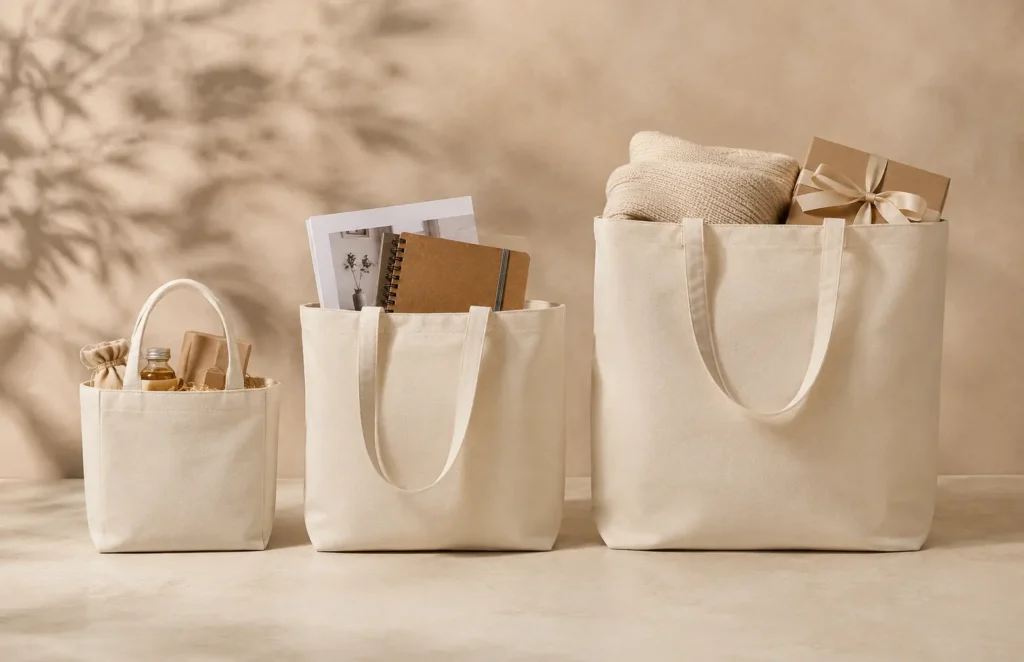
Gussets are particularly important when bags need to carry objects with depth.
A flat tote may work well for:
- documents
- thin notebooks
- brochures
- lightweight flat items
A gusseted bag may be more suitable for:
- gift boxes
- bottles
- folded clothing
- multiple products
- retail items
However, adding a gusset also changes the way the bag sits and how the printed area behaves near folds.
Critical artwork should generally remain away from areas that expand or crease.
If your project involves paper bags specifically, our paper bag material guide explains how gussets, handles and base construction work together.
How Tote Bag Size Affects Printing
Bag size and print size are related, but they are not the same measurement.
A larger tote provides a larger front surface, but the entire surface may not necessarily be available for artwork.
Print areas can be restricted by:
- handle attachment points
- seams
- side folds
- gussets
- bottom construction
- production limitations
Our tote bag design guide explains print areas, safe zones and artwork preparation in greater detail.
The main sizing principle is to think about how the artwork should appear relative to the bag.
A small logo may look appropriately subtle on a compact bag but appear visually lost on a much larger one.
Likewise, increasing the artwork simply because the bag is larger is not always necessary.
The bag dimensions and intended viewing distance should inform the final print size.
Size, Material and Construction Work Together
Tote bag size should never be considered completely independently from material.
Print Print currently offers paper, canvas and non-woven PP options, each suited to different applications.
A larger bag carrying heavier contents creates different demands on:
- handles
- seams
- base construction
- material weight
- gussets
For example, increasing bag dimensions does not automatically increase carrying strength.
A large lightweight bag may still be unsuitable for heavy contents if the handles or seams are not designed for that load.
Our tote bag thickness guide explains why material weight alone does not determine carrying performance, while our complete tote bag material guide compares the available material types.
Common Tote Bag Sizing Mistakes
Choosing Bigger “Just in Case”
Oversizing may appear safer, but it can create:
- unnecessary material use
- greater storage requirements
- higher shipping volume
- awkward presentation
- contents moving excessively inside the bag
Choose enough capacity for the intended contents plus practical clearance.
Ignoring the Gusset
Width and height alone do not show how much depth the bag provides.
This matters especially for boxes, bottles and clothing.
Measuring Only One Item
If recipients will receive several items, test the entire pack together.
Forgetting the Print Area
A bag may physically fit the contents while providing less useful artwork space than expected.
Assuming Size Names Equal Exact Dimensions
Terms such as A4 or A3 are useful references, but confirm the supplier’s actual finished measurements before approving artwork or packaging.
Ignoring Storage and Distribution
A larger bag takes up more space before it reaches the recipient.
For bulk event projects, hundreds or thousands of bags may need to be packed, transported and stored.
Our tote bag printing planning guide explains how physical products require more logistical planning than flat printed materials.
Practical Tote Bag Size Checklist
Before requesting a quotation, confirm:
-
what the bag will carry
-
dimensions of the largest item
-
total number of items per bag
-
whether the contents have significant depth
-
whether a side or base gusset is required
-
preferred bag width and height
-
required handle style or carrying length
-
desired artwork dimensions
-
selected material
-
required quantity
-
delivery date
-
whether standard or custom dimensions are preferred
If possible, provide these details together rather than asking for price based on size alone.
Material, dimensions, artwork and quantity can all affect final pricing. Our tote bag printing cost guide explains these cost factors in more detail.
Plan the Right Tote Bag Size with Print Print
 Choosing the right dimensions begins with understanding how the finished bag will actually be used.
Print Print currently offers standard A5, A4 and A3 tote bag size options, as well as custom dimensions for events, retail merchandise and premium gifts.
Through our custom printing services, businesses, schools, event organisers and individuals can coordinate bag size, material, artwork and production requirements around a specific project.
Explore our tote bag printing service, or WhatsApp Print Print with your intended contents, quantity, preferred material, artwork and required date for practical sizing guidance.
Final Thoughts: Choose Dimensions Around Real Use
A useful tote bag size guide should not simply tell you to choose small, medium or large.
The right dimensions depend on what needs to fit inside, how much depth the contents require, how the bag will be carried and how the printed artwork should appear.
Before production, consider:
- width
- height
- gusset
- contents
- material
- construction
- print area
- storage and distribution
A bag that matches its real purpose will usually perform better than one selected solely because it is larger or cheaper.
For recommendations based on your event, products or campaign requirements, contact us for a consultation on choosing the right tote bag dimensions for your custom printing project.
