




Deciding what to put on a pet ID card can be harder than expected. Your pet may have several nicknames, important dates and memorable characteristics, but trying to include everything can make a personalised card unnecessarily complicated.
Pet owners planning a custom keepsake can explore our pet ID card printing service. Print Print’s Pet IC-style cards are designed as personalised novelty keepsakes rather than official identification documents. Those new to the product can also read our Pet ID Card Singapore guide for a broader introduction.
This guide focuses specifically on which information to include and which details to prioritise. For the separate questions of physical dimensions and visual presentation, see our pet ID card size guide and pet ID card design guide.
Table of Contents
- Decide What Your Pet ID Card Is For
- Essential Details to Consider Including
- Choosing Useful Optional Information
- Accuracy and Privacy: What Should You Leave Out?
- Information for Gifts and Memorial Keepsakes
- How Much Information Should You Include?
- Practical Pet ID Card Information Checklist
- Create Your Personalised Pet ID Card with Print Print
- Final Thoughts: Choose Details That Matter
Decide What Your Pet ID Card Is For
Start with the purpose of the card rather than immediately filling in individual fields.
A personalised pet card may be created as:
- an everyday keepsake
- a birthday present
- a gift for another pet owner
- a playful Pet IC
- an adoption keepsake
- a memorial item
- part of a collection for several pets
The purpose helps determine which information deserves attention.
For example, a simple everyday keepsake may need only the pet’s name, photograph and a few identifying details. A gift may include a family nickname or meaningful date. A memorial card may place greater importance on dates and a short remembrance message.
Starting with the purpose prevents unnecessary information from being added simply because another field is available.
Essential Details to Consider Including
There is no compulsory information that every personalised pet card must contain. However, several details provide a useful starting point.
Pet Name
The pet’s name will usually be one of the most recognisable pieces of information.
Use the version that the owner naturally associates with the pet. This may be:
- the everyday name
- a familiar nickname
- a shortened version of a longer name
If your pet has several nicknames, you usually do not need to include all of them.
Pet Photograph
Most personalised pet cards feature a photograph because it makes the keepsake immediately recognisable.
At this stage, the important decision is simply choosing the photograph you want associated with the card.
Questions about image sharpness, lighting, cropping and resolution belong to the separate pet ID card photo tips guide, which explains how to prepare an image for print.
Breed or Pet Type
Breed or pet type can provide useful supporting information.
Examples might include:
- Golden Retriever
- Toy Poodle
- British Shorthair
- Domestic Shorthair
- Holland Lop
- Mixed Breed
If the exact breed is unknown, use a general description rather than guessing.
Accuracy is more useful than filling every possible field.
Birthday or Adoption Date
A date can make the card more personal, especially when it represents an important milestone.
Possible options include:
- date of birth
- estimated birth year
- adoption date
- gotcha day
- year the pet joined the family
If the exact birthday is unknown, an adoption date may be more meaningful anyway.
A date is optional. Include one because it matters to the owner, not because a personalised card is expected to imitate an official identity document.
Choosing Useful Optional Information
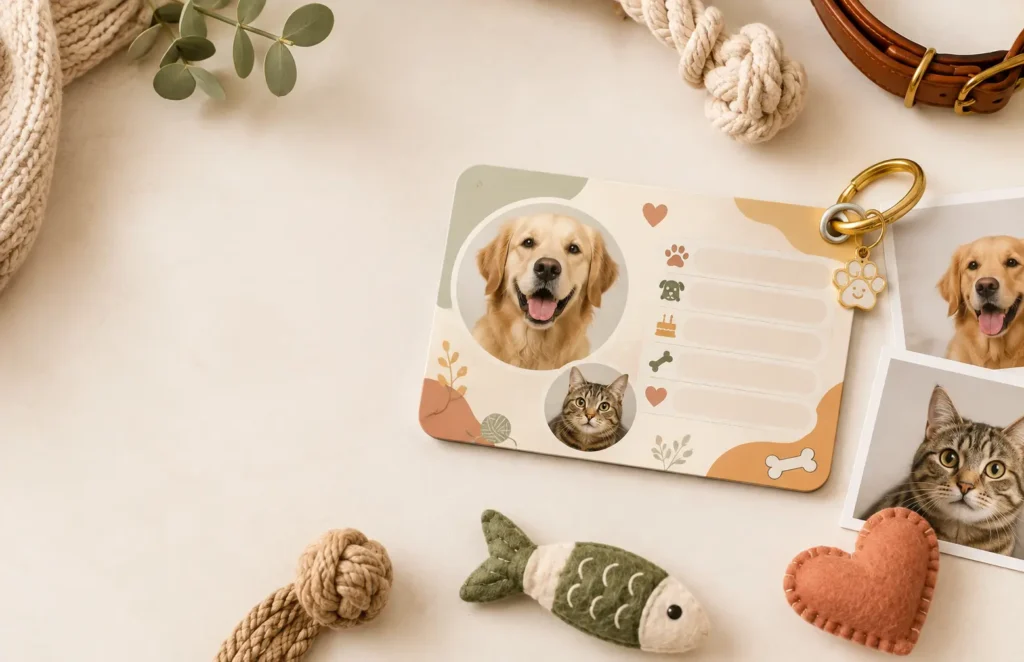
Once the core information is confirmed, you can consider adding one or two optional details.
These might include:
- personality trait
- favourite activity
- favourite food
- family nickname
- short personal message
- playful title or role
The objective is not to create a complete biography. Optional information should help the card feel specific to the pet.
For example, adding one familiar characteristic may be more meaningful than including weight, several nicknames and multiple dates.
If you are looking for creative examples, humorous titles or personality-based concepts specifically for dogs and cats, our Custom Pet ID Card Ideas for Dogs and Cats guide covers that search intent in greater depth.
Keeping those creative ideas in a dedicated article allows this guide to remain focused on information selection.
Accuracy and Privacy: What Should You Leave Out?
Knowing what not to include can be just as important.
Because personalised Pet ICs are primarily novelty keepsakes, they usually do not require sensitive personal information. Print Print also allows customers to omit sensitive details when customising their cards.
Consider leaving out:
- full residential addresses
- identity document numbers
- unnecessary private phone numbers
- detailed medical records
- information copied from official documents without a reason
- dates you cannot confirm
- guessed breed information
- lengthy paragraphs
You should also avoid presenting a novelty card as an official licence or government-issued form of identification.
A personalised pet card should not replace practical identification methods such as a registered microchip or appropriate collar tag.
Our Pet ID Card vs Traditional Pet Tag guide explains why a keepsake card and an everyday identification tag serve different purposes.
Information for Gifts and Memorial Keepsakes
Different occasions may call for different information.
When the Card Is a Gift
When ordering for another pet owner, prioritise details you know are correct.
A straightforward combination might include:
- pet name
- photograph
- breed or pet type
- one confirmed date
- short personal message
A family nickname or adoption anniversary can make the card more personal, but confirm unfamiliar details before printing.
Incorrect information can weaken an otherwise thoughtful personalised gift.
When the Card Is a Memorial Keepsake
For a memorial card, owners may prefer a smaller number of meaningful details.
These could include:
- pet name
- favourite photograph
- birth year
- passing year
- adoption date
- meaningful nickname
- short remembrance message
There is no required memorial format. Some owners value dates, while others prefer a simple name and personal phrase.
For memorial-specific decisions, our Pet ID Card Printing for Memorial Pets guide explores the subject in more depth without turning this general information guide into a memorial article.
How Much Information Should You Include?

More information does not automatically create a more personal card.
A pet may have a name, three nicknames, breed, birthday, adoption date, favourite food, favourite activity and several memorable habits. That does not mean all of them need to appear.
A simple way to prioritise content is to work in three levels.
Level 1: Recognition
Start with:
- pet name
- pet photograph
Level 2: Basic Information
Choose one or two details such as:
- breed
- birthday
- adoption date
Level 3: Personal Information
Choose one or two:
- personality trait
- favourite activity
- family nickname
- short message
This provides enough information to make the card individual without trying to capture every fact about the pet.
The physical format also influences how much information can remain comfortably readable. Once the final information has been selected, our pet ID card design guide covers the separate question of how those details can be presented through typography, colour, imagery and spacing.
Practical Pet ID Card Information Checklist
Before submitting your content for printing, check that you have:
- confirmed the correct spelling of the pet’s name
-
selected the photograph you want to use
-
confirmed the breed or pet type if included
-
checked important dates
-
selected only the optional details that matter
-
confirmed family nicknames or messages
-
removed unnecessary sensitive information
-
checked information supplied by another person
-
decided whether the card is playful, sentimental or memorial-focused
You do not need to include every possible category.
The goal is to choose information that genuinely contributes to the finished keepsake.
Create Your Personalised Pet ID Card with Print Print

Once you have decided which information matters, the selected photograph and details can be prepared for professional printing.
At Print Print, personalised Pet IC-style cards can be customised with details such as names, breed, dates, photographs, colours and other selected information. Through our custom printing services, customers can also coordinate pet cards with other personalised printed items.
Explore our pet ID card printing service, or WhatsApp Print Print with your chosen photograph, pet name and information for practical guidance before placing your order.
Final Thoughts: Choose Details That Matter
Knowing what to put on a pet ID card is not about filling every available field.
Start with the information that immediately identifies the pet. Then add a small number of accurate, meaningful details that reflect the purpose of the card.
For one owner, that may mean a birthday and adoption date. For another, it may be a family nickname and short message. A memorial card may require even less information.
The strongest content is the information that helps the finished card feel recognisable and personal without becoming unnecessarily complicated.
For help turning your selected details into a printed keepsake, contact us for a consultation on your personalised pet ID card printing project.
Related Posts
- Pet ID Card vs Photo Book: Best Keepsake Comparison Guide
- Pet ID Card Printing for Memorial Pets: What to Consider
