

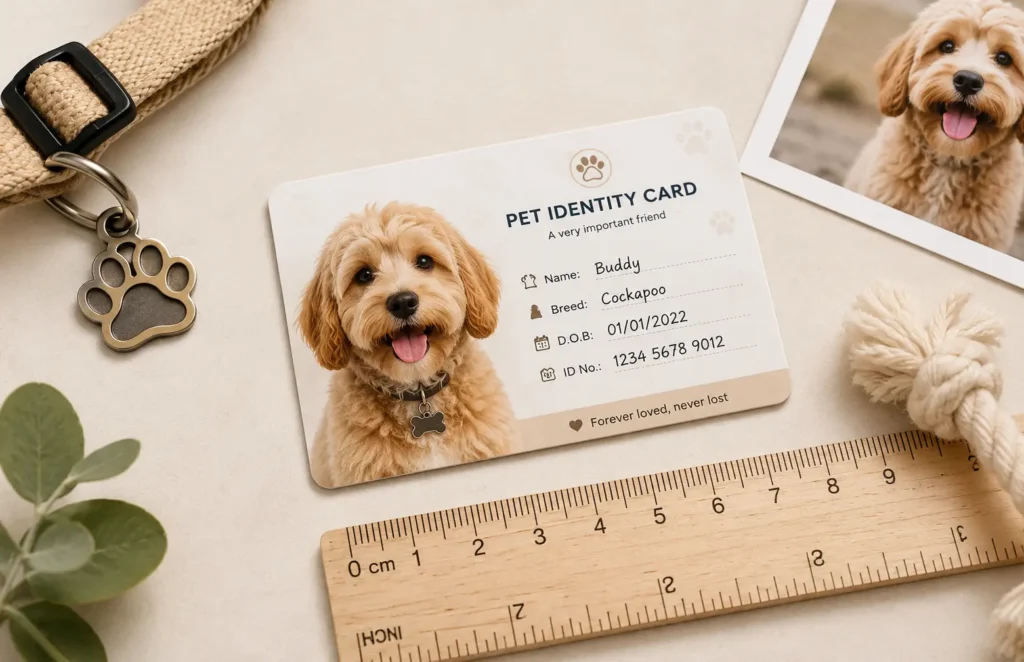
The pet ID card size used by Print Print is 85.60 × 53.98 mm with a thickness of 0.76 mm. The company describes it as similar in size to a standard credit card, creating the familiar compact format associated with a personalised Pet IC.
Customers can explore our pet ID card printing service for current product specifications and customisation options.
This guide explains what those dimensions mean in practice, including portability, usable space and readability at actual print size. If you are deciding which information belongs on the card, read our what to put on a pet ID card guide.
Table of Contents
- What Is the Pet ID Card Size?
- Why a Credit-Card-Sized Format Is Practical
- What the Dimensions Mean in Everyday Use
- How Pet ID Card Size Affects Available Space
- Why Actual-Size Readability Matters
- Understanding Pet ID Card Thickness
- Storage, Display and Keepsake Uses
- Common Size-Related Printing Mistakes
- Check Your Pet ID Card Specifications with Print Print
- Final Thoughts: Make the Most of a Compact Format
What Is the Pet ID Card Size?
Print Print currently lists the following specifications for its personalised pet cards:
| Specification | Measurement |
|---|---|
| Width | 85.60 mm |
| Height | 53.98 mm |
| Thickness | 0.76 mm |
| Material | PVC / polycarbonate |
The current product specification also describes the cards as waterproof with full-colour printing.
For customers, the easiest practical comparison is a standard credit-card-sized format.
The card is therefore considerably smaller than a postcard, flyer or conventional printed photograph. Its purpose is not to display a large amount of information. Instead, the compact format combines a recognisable pet image with carefully selected personalised details.
Although its proportions resemble familiar identification cards, Print Print’s Pet ICs are novelty keepsakes rather than official identification documents.
Why a Credit-Card-Sized Format Is Practical
A familiar card-sized format offers several practical advantages.
It can be easier to:
- store in a card holder
- include inside a personalised gift
- keep in a memory box
- add to a scrapbook
- display beside photographs
- collect as part of a matching set
The format works particularly well when the appeal of the product comes from resembling a compact personal card rather than a larger photograph or poster.
For households with several pets, using the same physical size can also create a coordinated collection without requiring substantial storage space.
The trade-off is limited surface area.
A larger print can accommodate longer messages, several images and more decorative content. A compact Pet IC requires greater selectivity.
That is why the physical dimensions should be understood before the artwork is finalised.
What the Dimensions Mean in Everyday Use
At 85.60 × 53.98 mm, the card is small enough to handle conveniently without requiring much storage space.
Owners may choose to:
- keep it with other cards
- place it inside a keepsake box
- display it on a desk
- include it with a gift
- add it to a pet memory collection
Portability is therefore one of the practical characteristics of the format, although there is no requirement to carry the card around.
Some owners may prefer to preserve it at home rather than place it in a wallet or bag, especially when the card has sentimental value.
If you are deciding between a compact individual keepsake and a format intended to preserve many photographs, our Pet ID Card vs Photo Book guide explains the different purposes of the two products.
How Pet ID Card Size Affects Available Space
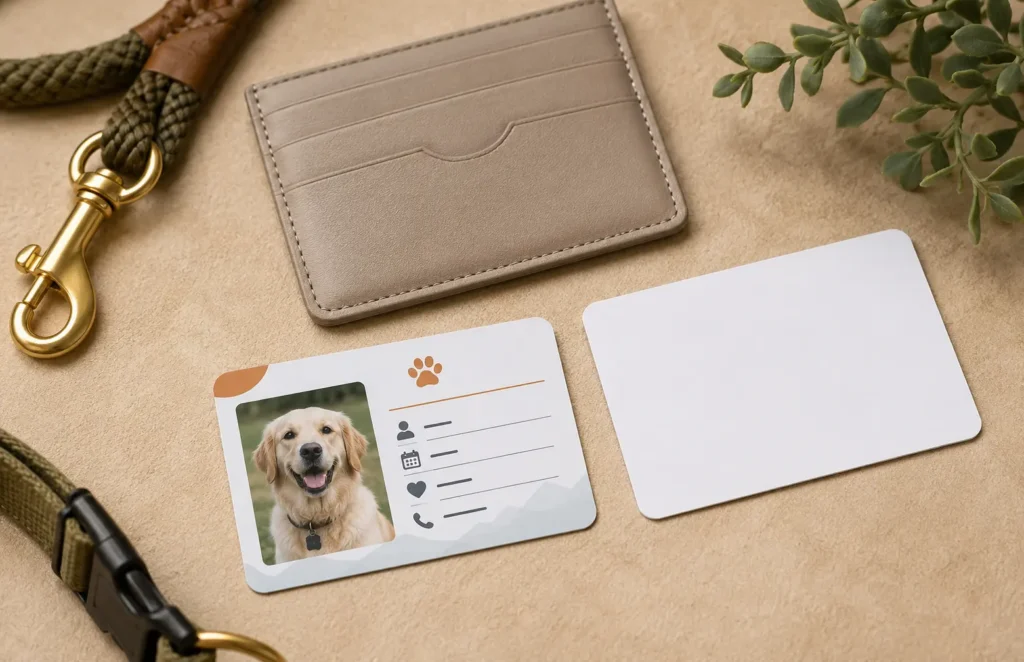
The physical dimensions place a natural limit on how much content can remain comfortably readable.
A compact card has less room for:
- long descriptions
- multiple photographs
- several dates
- numerous personality details
- lengthy memorial messages
- excessive decorative content
This does not mean the finished card should feel empty. It means the available surface should be used deliberately.
If you are unsure which details deserve the available space, our guide on what to put on a pet ID card provides a practical framework for selecting names, dates, supporting information and optional personal details.
Once those choices have been made, our pet ID card design ideas and layouts guide explains how the selected elements can be organised visually.
The three articles therefore answer different questions:
- What to Put article: Which information should be included?
- Size Guide: How much physical space is available?
- Design Guide: How should those elements be presented?
Keeping these decisions separate prevents space problems from being solved simply by shrinking everything until it technically fits.
Why Actual-Size Readability Matters
The physical dimensions of a Pet ID Card affect how text, photographs and small graphic elements appear once artwork is reduced to its final printed size.
Digital artwork is often viewed much larger on a computer screen than it will appear after printing. A design that looks spacious when enlarged may therefore feel noticeably denser at 85.60 × 53.98 mm.
This section focuses specifically on the limitations created by the physical card size. For guidance on typography, spacing and visual hierarchy, refer to our pet ID card design guide.
Text
Longer wording generally requires either more space or smaller type.
On a compact card, repeatedly shrinking text to accommodate additional information can eventually reduce readability.
If wording only becomes possible after the text has been reduced significantly, removing less important content is often a better solution.
Pet Photograph
A photograph also needs sufficient physical space for the pet to remain recognisable.
If the original image shows the pet very small within a large background, the animal may appear even smaller when the photograph is reduced to card size.
For questions about resolution, cropping, sharpness and lighting, refer to our dedicated pet ID card photo tips guide.
Fine Decorative Elements
Tiny icons, thin lines and small decorative details may look far more noticeable when the artwork is enlarged on a computer monitor.
At actual card size, those same details may become much less prominent.
The key principle is simple:
evaluate the design as a physical card, not only as a large digital preview.
Understanding Pet ID Card Thickness
Width and height are not the only physical specifications that affect how a personalised Pet IC feels.
Print Print’s current personalised pet card is listed at 0.76 mm thick and made using PVC or polycarbonate.
Thickness contributes to the physical feel and handling of the finished product while retaining the compact Pet IC format.
However, thickness should not be treated as a measurement of every aspect of quality or durability.
The finished result can also depend on:
- source photograph quality
- artwork preparation
- printing quality
- surface finish
- storage
- everyday handling
These are separate considerations from card size.
A future pet ID card material or durability guide can explore those factors in greater detail without turning this article into a broader product-quality guide.
Storage, Display and Keepsake Uses
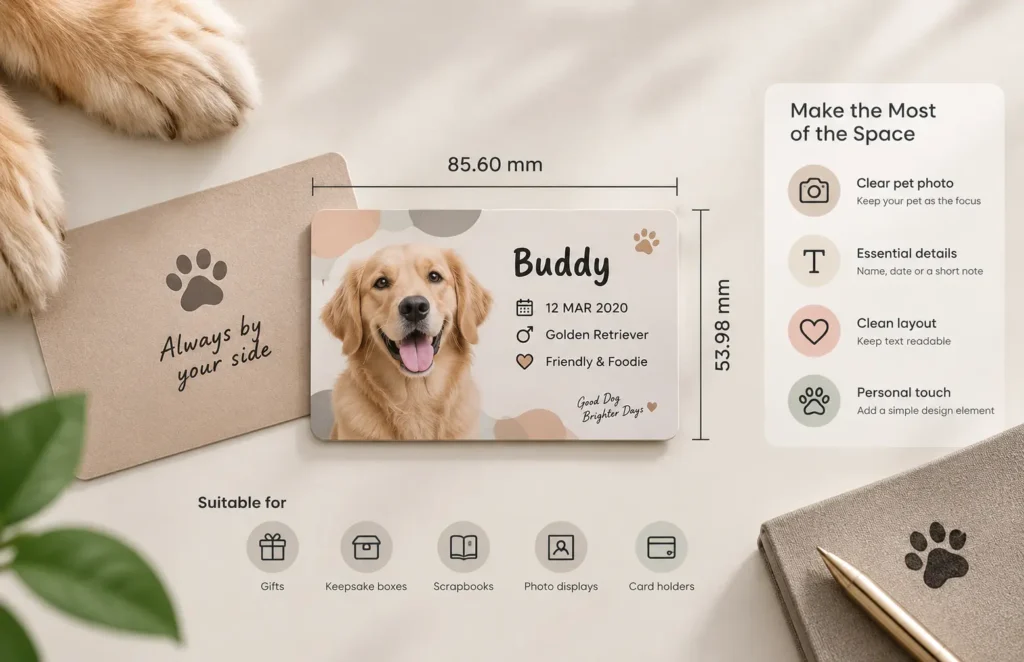
The compact dimensions allow a personalised pet card to be kept in several different ways.
Customers may store or display one:
- inside a card sleeve
- beside framed pet photographs
- in a desk display
- within a scrapbook
- in a memory box
- as part of a matching multi-pet collection
The most appropriate option depends on whether the card is primarily being carried, displayed or preserved.
A memorial card, for example, may be kept within a protected display or memory box. A playful everyday Pet IC may be handled more frequently or included alongside other personal cards.
The physical dimensions remain the same. What changes is how the owner chooses to use the compact format.
Common Size-Related Printing Mistakes
Several problems can occur when the final physical dimensions are considered too late in the preparation process.
Designing Only While Zoomed In
Artwork displayed at several times its actual size can make small text and graphics appear clearer than they really are.
Reviewing the finished design at a realistic physical scale can help reveal whether individual elements remain easy to recognise.
Trying to Fit Too Much Information
If the content only fits after everything has been made extremely small, reduce the amount of information rather than forcing it into the available space.
The objective should be comfortable readability at the final printed size.
Confusing Photo Quality With Card Size
A small card does not automatically make a weak image suitable for printing.
Resolution, sharpness and cropping should still be evaluated separately through our pet ID card photo tips guide.
Ignoring the Actual Dimensions
Screen dimensions vary depending on monitor size, browser zoom and device settings.
The finished card remains 85.60 × 53.98 mm, regardless of how large the artwork appears on screen.
This makes actual-size review especially useful before final approval.
Solving Every Space Problem With Smaller Text
Reducing text size may technically make additional information fit, but this does not guarantee that the finished card will remain comfortable to read.
Physical space is limited. The solution is often to simplify the content rather than continually reducing the scale of every element.
Check Your Pet ID Card Specifications with Print Print

Understanding the pet ID card size before preparing artwork can help prevent overcrowded information, overly small text and photographs that lose impact once reduced.
Print Print currently offers a card measuring 85.60 × 53.98 mm with a thickness of 0.76 mm, using PVC or polycarbonate with waterproof full-colour printing.
Through our custom printing services, customers can also coordinate Pet ICs with other personalised print projects.
Explore our pet ID card printing service, or WhatsApp Print Print with your photograph and project requirements for practical production guidance.
Final Thoughts: Make the Most of a Compact Format
The pet ID card size is one of the features that gives the product its familiar Pet IC appearance.
At 85.60 × 53.98 mm and 0.76 mm thick, the card is compact enough for convenient storage and handling while still providing space for a pet photograph and carefully selected information.
The goal is not to determine how much content can technically be squeezed onto the surface.
Instead:
choose the information that matters, understand the available physical space, and then develop a design that remains clear at its real printed size.
For help preparing your artwork around the actual card specifications, contact Print Print for a consultation on your personalised pet ID card printing project.
Related Posts
- Pet ID Card vs Photo Book: Best Keepsake Comparison Guide
- Pet ID Card Printing for Memorial Pets: What to Consider
